

























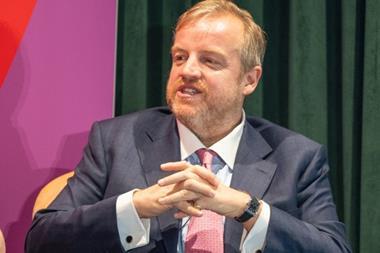
Adam Harper, CII executive director for strategy, advocacy and professional standards, discusses the importance of the industry’s support for the Financial Services Skills Compact
The future competitiveness of the insurance profession rests not only on attracting new talent, but on equipping today’s workforce with the skills, judgement and professional standards needed to adapt as fast as technological change.

As AI, automation and data reshape financial services, workforce development is becoming a strategic priority for insurers, brokers and professional bodies alike.
And, as a full member of the Financial Services Skills Council (FSSC), the CII is directly engaged in helping to deliver its purpose. One of the examples of this engagement is as a supporter of the recently launched Financial Services Skills Compact.
The Skills Compact, launched as part of recently replaced chancellor Rachel Reeve’s Mansion House agenda in mid-July, is a joint commitment between government and the financial services sector to address sector-wide skills shortages and has been described by the FSSC as the most significant government-employer skills agreement in a generation.
It is important not simply because it addresses skills shortages, but because it identifies that future competitiveness, professionalism and customer trust are inseparable.
At the CII, we recognise that the insurance profession’s future strength depends critically upon the skills and professionalism of its people. We must ensure that insurance professionals – the humans in the loop – continue to deliver the highest standards of service to customers, firms and wider society in an AI-enabled age.
Preparing for the future
Future insurance skills are unlikely to be purely technical. Insurers will need people who can work effectively with AI and automation tools, interpret increasingly complex data, exercise professional judgement, understand evolving customer needs, navigate regulatory expectations and maintain ethical standards in technology-enabled decision making.
Read: Do not sleepwalk into the knowledge transfer risk
Read: Rising AI uptake drives demand for sector-wide skills update
Explore more talent-related content here or discover more briefing articles here
The FSSC compact commits firms, including its founding insurer signatories, to upskill employees in AI and other critical capabilities to ensure the sector remains competitive.
It is particularly relevant for insurers, because we know they are dealing with ageing workforces and increased demand for digital and analytical skills. The signatories have also committed to attracting new entrants to the sector by developing new talent pipelines and expanding structured entry routes.
The CII has an important role to play in delivering the ambition of the compact given its role as a bridge between employer demand for future-ready skills and the broader goal of maintaining confidence and the profession’s obligation to maintain public trust.
While the compact focuses on tackling skills shortages and accelerating AI-related capability building, the CII’s engagement enables us to highlight the continuing importance of professionalism, ethics and lifelong learning.
The CII’s support for the compact is part of its broader and longstanding involvement with the FSSC – we have also participated in workshop sessions and roundtable events to support its HM Treasury-commissioned research on AI and disruptive technologies.
This research is exploring how the financial services sector is able to attract and develop the highly-skilled workforce it needs over the next ten years. We will be delighted to be able to engage closely with the FSSC on the development of its research and the resultant recommendations that will emerge from it.
There is clear evidence that the insurance sector is moving from seeing future workforce development as not just a recruitment challenge, but also a workforce transformation challenge.
The urgent necessity today is that the insurance profession responds to the skills challenge with ambition and coherence, ensuring that technical capability is matched by professional judgement, ethical decision-making and a relentless focus on good customer outcomes.
Through its support for the skills compact and wider engagement with the FSSC, the CII is committed to helping the profession build the skills, professionalism and resilience it will need for the future.
































No comments yet