









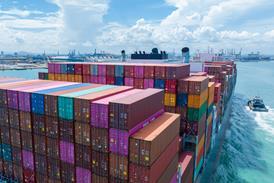

















Insurance is playing a role within US president’s chess game with Iran, as Donald Trump introduces political risk cover for maritime trade venturing into the Persian Gulf. But what can the UK learn from this?
Whether we like it or not, the biggest political issues of our age are always relevant to the insurance market. This was the case for the Covid-19 pandemic and it is the same for the latest world conflict between the US and the Middle East.
But how long can UK general insurance (UKGI) sustain being reactive in an era of resurgent strategic risk?
Insurance once again featured across global media in March 2026 as US president Donald Trump announced his intention to launch a political risk insurance mechanism via his government’s US International Development Finance Corporation (DFC), designed to protect maritime trade on its transit through the Persian Gulf.

Government war risk coverage obviously is not new.
The UK has had a dormant fund for this purpose since 1952. Further back, in 1914, the UK government launched the War Risks Insurance Office (WRIO). The former has no capital in it right now and data from the latter is not easily accessible.
Notably, what I have termed Trump Re offers more than just cover – it provides a security escort for ships. However, for the UK, a Royal Navy with a much smaller fleet does not inspire confidence for any equivalent programme – especially as our leaders believe we need five years to prepare for a real war.
The UK would struggle to replicate what Trump has implemented – we need far more ships, but where does the budget come from?
What if the aforementioned dormant fund, London’s marine coverage, the shipping register collective the Red Ensign Group and the Royal Navy aligned further?
Given the huge sums of capital insurers have under their management and the evolution of strategic investment regimes like 2023’s Mansion House Compact – where pension providers allocate a portion of their default funds to unlisted equities – insurance’s vast capital base could become part of the solution.
Given that around 40,000 commercial ships are controlled by Western allies – many flagged with open registries – this is an obtainable market for UKGI to become more involved in.
Beyond Trump Re, there is only one Western nation that combines competent legal and regulatory oversight, world-class marine and war risk coverage and a navy of reputation and reach. It is the UK folks.
Consider the building of an emergency fleet of dozens of new UK escort frigates – treated more like a private vehicle financing exercise.
Construction costs could be loaned by insurers and contracts considered a regulatory, solvency regime approved asset. There is also an income offset available from pricing it into the flag registry or a maritime authority. Private security firms like Ambrey already offer a combination of Lloyd’s coverage and fleet escort vessels.
Country collaboration
Offering this kind of strategic thinking to the government gets them out of a very big hole. It also makes the benefit of having a UK flag more potent on a global stage.
Scaling up shipyards takes time, however.
Read: Briefing – Shockwaves will be felt in London as missiles fly in the Persian Gulf
Read: Briefing – What does the Q1 2026 Middle East conflict mean for travel insurance?
Explore more risk management articles here, or discover more briefings here
With resources from trilateral security partnership Aukus, such as Australia, and industrial partners like South Korea and Japan through free trade ties, a joint venture could be possible to accelerate progress. There is precedent – via the joint Global Combat Air Programme (GCAP) initiative between UK, Japan and Italy to build a sixth generation fighter.
With plans for GCAP’s frigate announced in 2022 and an associated treaty signed in 2023, the type 31 warship has been designed to be affordable, slated to cost around £250m. It is planned to be operational from 2035.
The government covers the running costs and a sinking fund to pay off the debt. As economic stimulus goes, it is net positive. It is definitely not feasible if the politicians have to fund it all now.
Doubtless, the Ministry of Defence would ask about crewing.
The end of a ship’s life might help. We literally just sold two assault ships to Brazil. Even more allies like Ukraine have purchased naval vessels from us over the last 50 years. There may be a pool of trainable crews there, led by a layer of Royal Navy officers. Participant allies could pay an option and training costs, so the depreciated value is clearer.
Acting with purpose
When Trump Re was born, one wondered whether the guarantee and presence of a US fleet escort actually increased the risk to vessels and made them more attractive targets. This is certainly a valid point. But the world is not getting any safer.
To extol the virtue of the insurance industry finding its collective political purpose is to often speak to a room of averted eyes, but tell me we do not have an impending obligation? For whom the bell tolls.































No comments yet