























Sponsored content: Maxim Dobrov, consultancy and professional services sector lead at Hiscox, discusses the risks that can arise from the increased use of informal communications in professional services
1. What has prompted the risk revaluation around informal communications in professional services?
Consultancy and professional services is one of Hiscox’s key specialist sectors, so this is an area we pay close attention to.

We’re seeing a clear shift in how consultancy and professional services firms communicate with clients. Messaging platforms, direct messages and group chats are now embedded in day-to-day delivery, not just occasional touchpoints.
The channel itself isn’t new, but the way it’s being used is. There is often a perception that this type of communication is off record, but that’s not that case.
What’s more, these more informal exchanges can blur the boundaries around scope, authority and what’s been agreed – and we’re seeing them play a more noticeable role in the claims process than they did five or ten years ago.
That combination of widespread adoption and growing relevance in disputes is what prompted us to explore the issue in more depth.
2. What are the real world risks of this type of communication and how can this lead to liability for clients?
The real-world risks will, of course, depend on the type of business involved.
At one end of the scale, they may include regulatory or compliance issues – at the other, they may be as simple as a miscommunication that later forms part of a dispute.
Informal channels can encourage quick, shorthand responses and some clients may feel pressure to be always on and immediately available through this type of communication.
That can increase the risk of advice being given without the usual level of care, context or record-keeping. It can also contribute to scope creep, where a desire to be helpful, through contributing to group chats or offering informal views, is later argued to have resulted in a breach of contract, negligence or omission.
Certain businesses, particularly regulated ones, also have a duty to maintain high standards of record-keeping, which can be more difficult to uphold when communication takes place through informal channels.
3. How can those in consultancy or professional services roles protect themselves against this type of claim?
We believe our clients are best placed to understand their own businesses and how they choose to communicate with their customers. Our aim was to highlight an issue that is becoming more common and encourage firms to think about it in the context of their own business and sector.
Our role as an insurer is to be there for clients if they need us, not to prescribe exactly how they should consult or advise their customers.
Depending on the circumstances, firms may want to consider practical steps such as using authorised communication platforms, training staff, following up in writing where appropriate and maintaining robust record-keeping practices. These can all help professional firms reduce the risk of professional negligence claims and support better service for their customers. We continue to offer cover for our clients regardless.
4. Are there any particular claims trends you’re seeing that can be illustrative for clients?
There are some specific and more extreme examples making their way through the courts, such as the test case involving London-based painter Hsiao Mei-Lin, who is arguing for the legally binding nature of a WhatsApp message.
More broadly, however, we observe this issue more often as a contributing factor in a claim dispute than as the central cause of a negligence or breach of contract claim. In other words, claims may allege negligence or a breach of agreed terms, with examples of informal communication or advice then used as part of the supporting evidence.
5. What is the key message brokers should be delivering to their clients to help manage this risk?
In my view, the key message is simply to encourage clients to think about the issue.
Once businesses are aware of the risk, we trust them to assess it in the context of their own operations and make the decisions that are right for them. Brokers can play an important role in highlighting this developing trend and making sure clients are aware of it.
As insurer, our role is to continue to be there for clients should they need us in the event of a claim.
Webinar: Informal comms, formal risk
Insurance Times and Hiscox will host a webinar on the subject of this article later in June.
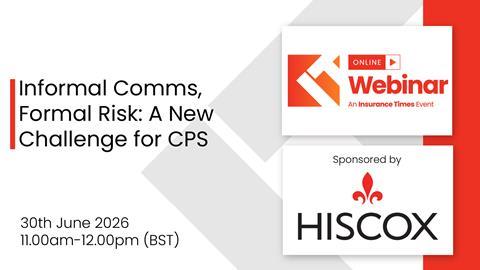
The discussion will also address the potential operational impact on firms, including challenges around record keeping and audit trails, alongside the expectation of constant availability.
For brokers, the webinar will provide insight into a changing risk landscape within consultancy and professional services.
- To register for the online session, click here.
- To view Hiscox’s new report on the subject of informal communications, click here.