












![acquisition three jigsaw]](https://d17mj6xr9uykrr.cloudfront.net/Pictures/274x183/4/9/8/122498_acquisitionthreejigsaw_905211.jpg)











A new survey from Insurance DataLab sheds light on how claims experience is shaping broker behaviour – and why it is becoming a critical tool in navigating an increasingly complex placement landscape
Placing business in today’s UK general insurance (UKGI) market is becoming increasingly complex.

Brokers are operating in an environment shaped by tightening capacity, evolving underwriting appetites and heightened regulatory expectations – all while being expected to evidence good customer outcomes at every stage of the policy lifecycle.
Against this backdrop, one factor is emerging as particularly influential – claims performance.
Insurance DataLab’s newly launched Commercial Lines Claims Pulse Survey, built from more than 800 real-world claims experiences in partnership with Research in Finance, has been designed to address a growing challenge for brokers – how to assess insurer performance in a way that genuinely supports placement decisions.
The findings, published exclusively by Insurance Times, reinforce what many in the market have long suspected, but have struggled to evidence consistently – that claims experience is not just a service issue, but a decisive commercial driver.
Trust at the point of claim
At its core, the survey highlights a direct and measurable relationship between claims experience, broker trust and future placement behaviour.
Read: Insurers awarded as London market claims performance at decade high – Gracechurch
Read: An arms race is brewing in claims handling
Explore more claims-related content here or discover other news analysis articles here
More than three quarters (78%) of brokers who reported an unsatisfactory claims experience said their trust in the insurer declined as a result.
That erosion of trust translates quickly into action. Some 39% of brokers say they are unlikely to place business with an insurer following a poor claims experience.
In contrast, positive experiences have a powerful reinforcing effect. Among brokers who reported a good claims outcome, 95% said they would be likely to place business with the same insurer over the next 12 months. For those dissatisfied, that figure falls to just 10%.
Taken together, the data makes clear that claims performance is not simply an operational consideration – it is a key determinant of business placement decisions.
Insurance DataLab co-founder Dan King said this provides new insight into how brokers are assessing insurer performance.
“Claims performance has always mattered, but what this data shows is how directly it now influences broker placement behaviour,” he explained.
“In a tighter market, brokers are placing far greater weight on evidenced outcomes, not just underwriting appetite or price.
“Those insurers that treat claims as a core part of their value proposition, rather than a back-end function, are the ones most likely to secure consistent placement.”
Mileage may vary
Encouragingly, the survey shows that the majority of brokers are broadly satisfied with the claims experience in the commercial lines market.
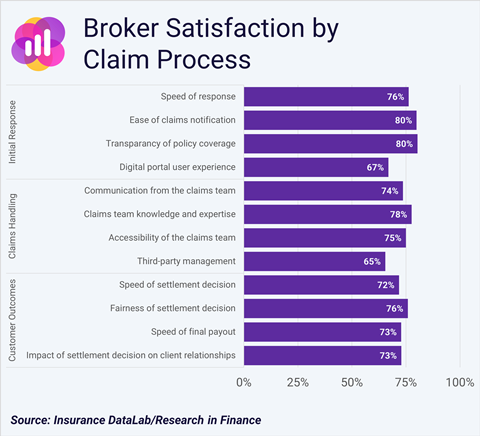
Overall, 77% of brokers reported satisfaction with their claims experience.
Brokers were most satisfied with insurers’ initial response, which had an average satisfaction rating of 76% across speed of response, ease of claims notification, transparency of policy coverage and digital portal user experience.
Satisfaction with claims handling and customer outcomes, meanwhile, both average 73%.
However, these headline figures mask meaningful variation across business lines – an important consideration for brokers when placing risk.
Satisfaction is highest in business equipment and office contents insurance, where 87% of brokers report positive experiences.
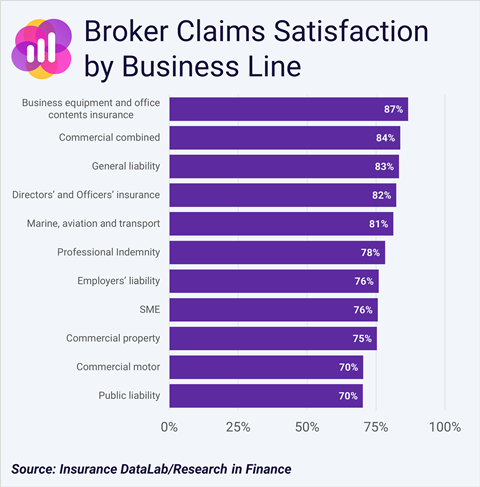
Other strong performing lines include commercial combined (84%), general liability (83%), directors’ and officers’ insurance (82%) and marine, aviation and transport (81%).
At the lower end of the scale, commercial motor and public liability both record satisfaction levels of 70%.
These differences are significant, reflecting the varying complexity of claims across lines, as well as the operational and cost pressures affecting insurers – from claims inflation and supply chain disruption to shifting risk profiles.
Top performing insurers
The survey also highlighted notable differences between individual insurers, asking brokers to rate each insurer for overall satisfaction, as well as across three key pillars – initial response, claims handling and customer outcomes.
The data reveals a clear group of leading performers. Beazley tops the rankings with a 92% overall satisfaction score, underpinned by consistently strong performance across all three pillars of the claims journey.
It achieves an initial response score of 86%, supported by high satisfaction across key front end metrics including speed of response (86%), ease of claims notification (86%) and transparency of policy coverage (91%).
This strong early stage performance is matched by equally robust claims handling (84%), with brokers rating communication (86%), claims team expertise (86%) and third-party management (83%) highly.
Beazley is equally strong at the point of resolution, where broker satisfaction with customer outcomes reaches 84%. This is driven by particularly high satisfaction with the speed (81%) and fairness (88%) of settlement decisions, as well as the impact those decisions have on client relationships (85%).
That consistency across the entire claims journey helps explain its market-leading position – demonstrating the importance of delivering not just strong individual metrics, but a reliable end-to-end experience.
Travelers follows closely with a 91% overall satisfaction score, distinguished by its market-leading performance in claims handling.
It achieves the highest claims handling score in the survey at 86%, driven by standout results for communication (88%) and accessibility of the claims team (91%) – the highest score recorded across any insurer for this metric.
This is supported by a strong initial response score of 84%, with consistently high ratings across speed of response (88%), ease of claims notification (88%) and transparency of policy coverage (88%).
Customer outcomes are also rated highly at 81%, with brokers reporting high levels of satisfaction with both the fairness of settlement decisions (84%) and the speed of final payout (81%).
Allianz completes the top three with an overall satisfaction score of 87%, supported by a balanced and consistently strong performance across all stages of the claims journey.
It receives an initial response score of 83%, with particularly strong results for speed of response (86%) and transparency of policy coverage (89%), indicating a high level of clarity and responsiveness at first notification.
Satisfaction with claims handling is also robust at 80%, with solid performance across communication (81%), claims team expertise (85%) and accessibility (82%), contributing to a well-managed and consistent claims experience.
Customer outcomes are rated somewhat lower by brokers at 76%, but still above the market average.
AIG UK also features among the market’s strongest performers, achieving an overall satisfaction score of 83%, supported by particularly strong results in the early stages of the claims journey.
It records an initial response score of 81%, one of the highest among the insurers analysed, driven by strong performance in areas such as ease of claims notification (89%) and transparency of policy coverage (85%).
This strength at first notification is complemented by high satisfaction with claims team expertise (88%) and fairness of settlement decisions (89%), helping to support a consistently positive experience through to resolution.
Hiscox also achieves an overall satisfaction score of 83%, with its performance reflecting a balanced but slightly more variable experience across the claims journey.
While its initial response (72%) and claims handling (72%) scores sit below some of the top-ranked insurers, it delivers stronger outcomes at the point of resolution, with customer outcomes reaching 75%.
This is supported by solid scores for communication (78%) and speed and fairness of settlement decisions (both 77%), indicating that while early-stage processes may be less differentiated, outcomes remain a key strength.
Markel similarly records an overall satisfaction score of 83%, underpinned by consistently strong performance across both initial response and claims handling.
It achieves an initial response score of 78% and a claims handling score of 79%, supported by high satisfaction with ease of claims notification (83%) and transparency of policy coverage (86%).
This strong performance consistency continues through to customer outcomes (77%), with particularly strong scores for fairness of settlement decisions (82%), reinforcing its position as a reliable performer across the end-to-end claims journey.
The findings from Insurance DataLab’s Claims Pulse Survey reinforce a clear message – claims performance is now central to how brokers assess insurers in an increasingly complex placement environment.
In a market shaped by regulatory scrutiny, capacity constraints and the need to evidence good outcomes, claims data provides a tangible and practical way to differentiate between insurers.
King added that the data reinforces the central role of claims performance in shaping broker placement decisions.
“Those insurers that can deliver consistently across the claims journey – from first notification through to final settlement – are better positioned to build trust, secure placement and strengthen long-term trading relationships,” he argued.
“For brokers, the implication is equally clear – understanding how insurers perform in practice is no longer optional, it is becoming a core component of effective placement strategy.”






























No comments yet